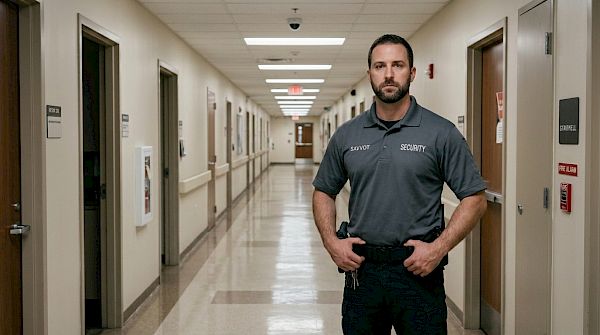
Technology Has Become Central to the Job
The most visible shift in the industry over the last decade is the integration of technology into day-to-day security operations. What used to mean a flashlight and a notepad now means AI cameras, GPS tracking, and real-time reporting — and today's guards need to be just as familiar with mobile apps as they are with their other equipment.This isn't technology replacing guards. It's technology making guards significantly more effective. Officers now use digital reporting platforms to log incidents in real time, with timestamped entries and photo documentation that creates a far more reliable record than handwritten notes ever could. GPS tracking verifies patrol coverage and gives clients transparency into exactly how their property is being protected.
AI capabilities within security technology are growing fast, with more tools leveraging AI to identify, prevent, and respond to threats — and major industry players have moved quickly to integrate these tools. Allied Universal, for example, extended its technology-integrated security services with a smart security system that meshes AI surveillance, facial recognition, and advanced analytics with human personnel patrols.
The result is a profession that demands more technical competence than it did ten years ago — and security companies that have invested in that training are delivering measurably better outcomes for their clients.
Remote Guarding Has Emerged as a Legitimate Alternative
One of the most significant developments of the last decade is the rise of remote guarding — live video monitoring by trained security operators who actively watch a site rather than simply recording it.
Remote guarding wasn't viable at scale ten years ago. Camera resolution, bandwidth, and monitoring platform technology weren't mature enough to deliver reliable real-time response. That has changed dramatically. Today, remote guarding operators can monitor multiple camera feeds simultaneously, issue live audio warnings to deter trespassers, and coordinate law enforcement response — all within seconds of detecting a threat.
For many businesses, this has created a new category of security coverage that sits between passive camera systems and full-time on-site officers. It's particularly valuable for large properties, after-hours coverage, and locations where a physical guard presence isn't practical around the clock.
Industry Specialization Has Become the Standard
Ten years ago, a security guard was largely a generalist. The same officer might work a retail store one week and a hospital the next. The industry has moved well past that model. Clients today expect officers who are trained specifically for the environments they work in. Healthcare security requires an understanding of patient rights, behavioral health situations, and how to de-escalate a distressed individual without disrupting clinical care. Education security requires a completely different approach to interacting with young people. Finance and banking security requires knowledge of incident response protocols and chain-of-custody procedures.Guards with expertise in specific verticals command a specialization premium — and that premium reflects real value. A specialist officer isn't just better at the job; they're less likely to create liability, more likely to respond correctly under pressure, and better equipped to represent the client's brand and culture.
De-escalation Has Become a Core Skill
The security industry's approach to conflict has shifted meaningfully over the last decade. The emphasis has moved away from physical intervention as a primary response tool and toward de-escalation — the ability to resolve tense situations through communication before they become physical.
This shift reflects both practical and cultural changes. Businesses increasingly understand that how a security incident is handled reflects on them — an aggressive or heavy-handed response can damage reputation, create liability, and harm the people the security program is supposed to protect. At the same time, research has consistently shown that de-escalation is more effective at producing safe outcomes than confrontational approaches.
For industries like healthcare, hospitality, retail, and education, de-escalation training is now a baseline expectation, not a differentiator.
The Demand for Security Has Grown Significantly
The market for professional security services has grown substantially over the last decade, and the trajectory continues upward. The global private security market is projected to grow at a compound annual growth rate of 7.8% from 2024 to 2030, with over 1.1 million security guards employed in the United States as of 2023.
That growth reflects a genuine increase in demand — from rising concerns about organized retail crime, workplace violence, and property threats, to the expansion of industries like healthcare, logistics, and technology that require specialized security programs.
Rather than hiring and managing in-house security teams, more organizations are partnering with professional security companies — a shift toward outsourced, contract security that continues to accelerate. The reasons are straightforward: professional security firms offer trained officers, management infrastructure, liability coverage, and the ability to scale staffing quickly in ways that in-house programs rarely can match.
Technology Complements Guards — It Doesn't Replace Them
There's been significant discussion in the industry about whether AI and automation will reduce the need for human security officers. The data tells a different story. The global manned guarding market grew by $6.5 billion in a single year — from 2025 to 2026 — reflecting sustained worldwide demand for boots-on-the-ground security. Technology enhances the effectiveness of human guards but does not eliminate the need for a physical, trained presence.The reason is intuitive. Technology can detect a threat. It takes a trained human being to respond to one with judgment, discretion, and appropriate force. The most effective security programs today combine both — using technology to extend coverage and accelerate detection, and relying on skilled officers to act on what that technology surfaces.
What This Means for Your Security Program
If your organization is still operating with a security program that looks the same as it did ten years ago, it's worth a serious evaluation. The industry has changed in ways that create real advantages for clients who are working with forward-thinking security providers — better documentation, faster response, more specialized training, and technology integration that extends coverage without proportionally increasing cost.The question isn't whether security guard services have changed. They have, significantly. The question is whether your current program reflects what's now possible.